Saturday, June 7, 2014

Where am I and where have I been?


I've been immersed within the PA program at Wayne State. I quit my job in March so I could focus more on school and have a little more time to do things I like to do outside of school and work...like play guitar and read....ride my bike....hail satan, you know....the usual. I use goodreads to update the books that I finish (which this year is embarrassingly low, maybe 2 or 3 books so far). Outside of school, I'm reading bits and pieces of various non-fiction works and am also about halfway done with the Dispossessed by LeGuin. Enjoying that book so far. The anarchist in me will never really die. These are beliefs/feelings are implanted within my very nature.

http://www.goodreads.com/user/show/13270476-mars-weston

Most of my reading is studying, which will become even more prevalent next year when I'll be in rotations and taking periodical quizzes and exams. I should stop referring to clinical year as next year. It's coming up in 3 months. I'm a bit nervous about it, as I feel completely unprepared for it. Most of the classes I've had thus far could have been better handled to help prepare students. As I've said, I felt like a number of the courses didn't do too much in terms of preparation for the professional year. We'll see when I actually begin though. Ah well. I guess I kind of expected to get most of the learning done in the second year anyway. Maybe I just need to have more confidence in myself. After all, I was selected to represent the program at the annual AAPA conference (in NY this year). Doc said I had the highest grade in his courses by a remarkable amount. He also says I'm great at giving presentations. I feel humbled by his confidence in me, no doubt about that. I just wish I had that confidence in myself that he seems to have. What a great man- supporting and knowledgeable to say the very least. I can't wait until the day comes when I don't feel slightly guilty for not studying when I know I could be. I guess I should get back to it.

Currently (and always) reading:


Sunday, January 19, 2014

A Canticle for Leibowitz

“....Nature imposes nothing on you that Nature doesn't prepare you to bear.”

“Soon the sun will set- is that prophecy? No, it's merely an assertion of faith in the consistency of events.”

A very interesting read. There were times when I thought it was simply okay, but upon reflection after finishing the book I can say that it is very good and memorable book. For me, this book worked in really subtle ways. It's not exactly what I was expecting it to be. The book deals with a serious subject (especially considering the time in which it was published, 1959)- life that follows centuries after nuclear devastation. While this book is regarded as a classic of science-fiction, I think it extends beyond that. This should really be a classic of American literature. Supremely crafted and written in a manner that is intriguing and, at times, cryptic. 

It picks up 6 centuries after nuclear war. In that time, there was a great backlash on the science and technology that created these weapons. People blamed science for the destruction and death throughout the land. They burned any book they could find, killed scientists, doctors, or any educated person. This was the time known as "The Simplification". Those who opposed these "Simpletons" worked to smuggle books through the American southwest to be transcribed and kept for future generations. Many of these people were caught and killed. One of these people is the man named Leibowitz who started an order in this tradition. The book is essentially divided into 3 parts:

FIAT HOMO: This is an age of little technology. In the 26th century (6 centuries after nuclear devastation), a young novice named Francis encounters a wanderer in the desert who essentially shows him the entrance to an ancient nuclear fallout shelter. In the shelter he discovers artifacts from 6 centuries earlier, including a letter (...shopping list) written by Leibowitz, the founder of his order. This causes a great uproar, as people are unsure whether Leibowitz was really the author.

FIAT LUX: For me, this was the hardest part of the book to read. It got a little dense at times and was told in a more didactic manner. 6 centuries after the previous story, this part serves as sort of a renaissance. In this age, a monk has just re-discovered how to produce electricity to emit light from an arc-lamp. More work is done to analyze the memorabilia and fragments of texts that could lead to advancements in science.

FIAT VOLUNTAS TUA: Easily the best part of the book for me (with the first part coming in a near 2nd place) Now in the year 3781, technology has soared past its current state. Humans are on their way to colonizing other parts of the solar system and science has grown to be an impressive force. So impressive that (inevitably) nuclear destruction once again threatens the existence of man. Nuclear explosions occur and there is talk about retaliation. The church orders a star-ship with several clergy, artifacts, and memorabilia to evacuate the earth before total destruction occurs.

Obviously, much more happens within the text that I won't write about. There are discussions of morality, religion, technology, and even suicide. The last subject is especially intriguing to me given the fact that later in his life, Miller became a recluse and took his own life in 1996. Even with the dense subject manner, this book tends to be very funny in unexpected places. It is one that makes you think after you are done reading it.


Saturday, November 16, 2013

I'm a little busy

The last months have been pretty eventful. Well, that is to say...eventful for my relatively uneventful life ;) I've still been reading plenty but recently have had limited time to do it. For my own sake of memory, I'll do a documentation of what's been happening.

        I was laid off from my job at the start of summer 2013. This turned out to be a “blessing” in disguise and probably the best thing that could have happened this summer. I liked the job. It was very easy, had time to read/study on the job, and the pay was okay with what I was doing. Upon being laid off, I promptly looked into 2 things: 1) unemployment and 2) going on a trip to the west coast. This proposed trip included making significant stops at various destinations in the american southwest, as well as Montana. Boy, am I glad I did. After a month of lazing around (I guess some moderate planning as well), I departed for Roswell, NM. From there, I traveled to Colorado, then to Utah where I spent a good amount of time. Roswell was…interesting. It was hot. Very fucking hot. I slept under the stars at Bottomless Lakes State Park which is either 12 or 18 miles out of town. The park itself is pretty neat. Like an oasis of various lakes, ranging from a feet in deepness to over 90 feet. I wasn’t sure how crowded it would be (4th of July weekend) so I made reservations at a large campsite which was dominated primarily by a myriad of recreational vehicles. Side note- fuck RV’s. Some are cool, yes. But these modern-day eyesores drive me insane. I come to these places to become acquainted with the land and environment, not your fucking goddamn gas-guzzling home-on-wheels. Oh well, what can I say? I am a hypocrite. Anyways, after sleeping at this state park, I decided to walk over to downtown Roswell, as the Roswell UFO festival was taking place. The idea of having a festival entirely based around aliens is awesome. And what can I say? I love E.B.E.’s. The festival itself was more mediocre than anything else. But while the UFO festival was lacking, other parts of NM made up for it. Being down there reinforced my appreciation for the atmosphere and landscape associated with the state. Bottomless lakes was pretty cool as well. It was nice out the first night, so I slept with the stars in plain sight. It was a little eerie, however, because while the sky was clear where I was, I could observe a significant storm several miles in the distance. It was far enough away so I couldn’t hear any thunder, but I was able to watch as sheets of lightening illuminate the darkened sky above me. As I lay there watching the sky, I felt a slight chill knowing that if I were to yell out, nobody would hear me. And then my mind went forth to start dreaming about alien abductions in the New Mexican desert. It wasn’t aliens (or animals, for that matter) that creeped me out. It was the idea that somebody could come up to where I lay asleep, vulnerable as a man upon a cross, and kill me. A little ridiculous? Perhaps. Because of my horrible ideas of what could happen, I slept with knife and pepperspray enclosed in my fists. I was awakened in the night by the sound of what I can only assume were desert coyotes howling at the waning crescent moon. I was reminded that it was only me out here, smiled, and went back to sleep. Fortunately (or unfortunately), I was not abducted and woke up with all my limbs intact the next morning. I caught the bus up to Grand Junction, Colorado, which was probably the best bus ride of the trip due to the great scenery surrounding the highways.
Once in Grand Junction, I rented a car and headed straight towards Utah’s beautiful national parks. I camped along the same campsite that Shawn and I had camped at 4 years previously and was happy to report that little had changed. Man, I love the atmosphere out there. I cannot say enough good things about the Canyonlands. I hope it stays protected. The last thing that place needs is more development. I went to Arches in the morning and will report that it was pretty crowded. I would love to have seen Arches National Monument as Edward Abbey saw it. Or Glen Canyon before a Dam existed. Thinking about these things makes me nostalgic for a time when I wasn't even alive. I probably get a little too emotional thinking about it. Then again, probably not. That area is one that I will continue to spend as much time in as long as I have the time and means to do so. As Mr. Abbey had put it, it is “the most weird and wonderful place on earth. There’s no other place like it.” I visited Isle in the Sky district of Canyonlands Nat’l Park. What a beautiful place. The air was so still, the atmosphere so tranquil. Given a choice, I’d welcome the opportunity to die in a place like that versus a hospital bed. I also realize that the tranquility in out there can change in an instant. God is apathetic towards the outcome of the humans (greetings, Vonnegut). A warm peaceful day can turn into a scorching hellfire where heatstroke and dehydration are the only plausible outcomes of a person’s fate. Furthermore, there exists the possibility of storms producing flash floods, sweeping away everything in its path. These things are relentless. Maybe that’s part of the reason why I love it so much. It is, by all means, a fortress of majestic solitude with dark undertones.
          From Utah, I went to the bay area where I visited my sisters, went up north to visit my Dad and other younger siblings, and traveled over to Yosemite for a couple days. There's no denying that Yosemite is a monumental park with spectacular sites. However, the development and the vast amount of people made for a less enjoyable experience. Did some nice climbing on several different trails and got to the apex of the tallest free-flowing waterfall in the United States. Would a trip like this be as fun if I had the company of other people? I know the answer to this question because I've been on a trip like this with other people. Going solo is a totally different experience.
          Out of California, I went over north and traveled east to Montana where I got a backcountry permit to do some quick two day hiking. I met two very nice girls who were from Portland and were doing a Glacier Nat'l Park hiking trip. I gotta say, I was a little jealous, as their route sounded great. They also had more time to spend there than I did. The first night in Glacier was okay. Fairly uneventful. I stayed in a group campsite where some other bicyclists were staying as well. They were nice but I kept to myself mostly. The next morning, I headed out onto the trail and was met head on with a deer. Considering that was the first sign of how this trek was going to be, I was sure to tighten my laces and keep eyes/ears open for any signs of other wildlife- mainly bears. If it's one thing that I have in common with bears, it's the fact that we both enjoy our solitude. Although a bear attack would be quite rare to happen, they do exist. The event that prompted strict restrictions on backcountry camping is known as "Night of the Grizzlies" in which 2 different people were killed by two different Grizzly bears in 2 different areas of the park. I did spot some scat on the trail, no bear sightings however. I camped in my solo tent the next night and hiked out about fifteen miles because I made good time to my intended destination. I felt like completing it all in one go. I did have a little scare as I was on the side of a mountain. I was hiking along a steep incline covered with snow in the absence of a trail. I slipped and slid down the slope a few feet before I managed to catch myself. A little scary, but not life-threatening. That night and the subsequent nights on the train were a little sad because it marked an ending to what was undoubtedly one of the best experiences of my life. I arrived in Detroit pretty late where my friends met me with smiling faces. Can't wait to do it again.
     During my time traveling, I was accepted into WSU's anatomic pathologists' assistant program, for which I had interviewed in June. It was great news, however, a pretty tough decision. Another two years to dedicate to studying and school. Then I figured that the good outweighed the bad. I would be studying pathology- an awesome subject filled with a massive amount of interesting information. If I apply myself correctly, I can get a job right out of graduation with great starting salary wages. Yes, this is where it sounds like I sell out for the money. Eh...maybe that's true to some extent. I told myself once that I will take my time trying to find alternative ways of "living". But in the meantime, if I am to be part of a system that makes me work to live, I'd rather make it count. Have a job that I like doing for a decent amount of money versus having a job that I hate doing for dollars and quarters. That was a decision after working my first job at Salvation Army for a year and half at minimum wage. I hated it.
          On top of the solo traveling and school stuff, I had some band stuff happening. We played in Chicago for Ragnarokkr festival. I had the amazing opportunity of sharing the stage with Winterhawk, who's album "Revival" is among the best hard rock albums EVER recorded. No exaggerations whatsoever. Amazing. Plus Ashbury played the previous night, which was an incredible experience. Finally, Oz closed out the second night with an exceptionally rocking set. Those 3 bands in particular really blew me away and made the entire weekend worth it. That festival was with Demon Bitch. On the more extreme side of things, Isenblast also played a show out in Maryland in front of a bunch of crazy metalheads. The show was itself was okay. It was more fun traveling in the van and partying with some guys from the show afterwards. Went to sleep at 7am to wake up at 9am. Always a great choice.
         I started the APA program in late August and as soon as that started up again, I got a call from my previous job asking if I wanted to come back to work. Whoa. I accepted and am now fully immersed in the program and working part-time. I'll do it as long as I can before I have to voluntarily quit.

     Here's a list of books that I read starting from June until now:
-Desert Solitaire
-My First Summer in the Sierra
-Into Thin Air: A Personal Account of the Mt. Everest Disaster
-Confessions of a Barbarian
-Heavy Liquid
-Ishmael: An Adventure of the Mind and Spirit
-God Bless You, Dr. Kevorkian
-Where White Men Fear to Tread: The Autobiography of Russell Means
-Earth Apples: Collected Poems
-The Monkey Wrench Gang
-A Wrinkle in Time
-The Giver
-Clive Barker's Hellraiser: Book 1
-The Lion, the Witch, and the Wardrobe
-The Fool's Progress
-The Illustrated Man
-I Am a Barbarian
-Ojibwa Warrior: Dennis Banks and the Rise of the American Indian Movement
-A Princess of Mars
-Orbiter

-Watchmen

The Stars My Destination - by Alfred Bester


This post is pretty old. Oh well, it was saved as a draft last year some time but never published because I was too lazy. Seeing as how I totally forgot that this blog existed, I'll go ahead and post this here. This was a very fun read. Somewhat of a landmark too, it had some experimental and artistic passages near the climax and end. The way some of the text is laid out has you twisting the book in all sorts of directions, which invokes a feeling of dizziness, chaos, and confusion. I think some other authors saw what a unique idea this was and pushed it to the extreme (i.e. House of Leaves). A great book overall, the kind I that I would be glad to give another read in the future. Now for what I originally wrote about it:

Alfred Bester wrote a superb science fiction classic. He actually might have written two, but I still have not read The Demolished Man. The main protagonist in the Stars My Destination is not the most likable person. In fact, he's kind of a dick. But he becomes mildly likable by the end of the book. As I think more about the plot of this book, I can't help but compare it to the Count of Monte Cristo. I definitely cannot be the first person to come up with that comparison either. This seems like a sci-fi version of the tale. There's a lot of adventure elements in it- all involving space ships, asteroid colonies, underground prisons, circus people, among a billion other things. More than anything else, this book turns into a piece of art at the end. The text is arranged in crazy ways during parts of the book which enhance the disorientating feeling. It is a pretty unique book that stands alone.

I'm too tired to write about plot, it's 7am and I get off of work in 30 minutes. Here's how Wikipedia describes the plot:

"In the 25th century, "jaunting" – personal teleporation – has so upset the social and economic balance that the Inner Planets are at war with the Outer Satellites. Gully Foyle of the Presteign-owned merchant spaceship Nomad – an uneducated, unskilled, unambitious man whose life is at a dead end – becomes a victim of the war when the ship is attacked and he alone survives. After six months of waiting for rescue, a passing spaceship, the Vorga, also owned by the powerful Presteign industrial clan, ignores his signal and abandons him. Foyle is enraged and is transformed into a man consumed by revenge, the first of many transformations.
Foyle repairs the ship, is captured by a cargo cult which tattoos a hideous mask of a tiger on his face, escapes and is returned to Terra. His attempt to blow up the Vorga fails, and he is captured by Presteign. Unknown to him, the Nomad, was carrying "PyrE", a new material which could make the difference between victory and defeat in the war. Presteign hires Saul Dagenham to interrogate Foyle and find the ship and PyrE.
Protected by his own revenge fixation, Foyle cannot be broken, and he is put into a jaunte-proof prison, where he meets Jisbella McQueen, who teaches him to think clearly, and tells him he should find out who gave the order not to rescue him. Together they escape and get his tattoos removed – but not with total success: the markings come back when Foyle becomes too emotional. They then head out to the Nomad, where they recover not only PyrE, but a fortune in platinum. Jiz is captured by Dagenham, but Foyle escapes.
Some time later, Foyle re-emerges as "Geoffrey Fourmyle," a nouveau richedandy. Foyle has rigorously educated himself and had his body altered to become a killing machine. Through yoga he has achieved the self-control necessary to prevent his stigmata from showing. He seeks out Robin Wednesbury, a one-way telepath, and convinces her to help him charm his way through high society.
Foyle tracks down the crew of the Vorga to learn the identity of the ship's captain, but each is implanted with a death-reflex and dies when questioned. Each time, Foyle is tormented by the appearance of "The Burning Man", an image of himself on fire.
At a society party, Foyle is smitten with Presteign's daughter Olivia. He also meets Jisabella again – now Dagenham's lover – who chooses not to reveal Foyle's identity, although Dagenham has realized it anyway. Then, during a nuclear attack by the Outer Satellites, Foyle goes to Olivia to save her. She tells him that to have her, he must be as cruel and ruthless as she is.
Robin, traumatized by the attack, tries to buy her way out of her arrangement with Foyle with the name of another Vorga crew member. Foyle agrees, but immediately reneges. In response, Robin goes to Central Intelligence to betray him.
Foyle learns that the captain of the Vorga had has all her sensory nerves disabled and is thus immune to conventional torture, and that the ship did not rescue him because it was picking up refugees, taking their belongings, and scuttling them into space. He kidnaps a telepath to interrogate the captain, and learns that Olivia Presteign was the person in charge. Olivia rescues him fromcommandos, as she sees in Foyle someone who can match her hatred and need to destroy.
Driven by a guilty conscience, Foyle tries to give himself up, but is captured by Presteign's lawyer, who turns out to be a spy for the Outer Satellites. He tells Foyle that when the Nomad was attacked, Foyle was taken off the ship, transported 600,000 miles away, and set adrift in a spacesuit be a decoy to attract ships to be ambushed. Instead, Foyle space-jaunted – a previously unknown possibility – back to the Nomad. Now, the Outer Satellites not only want PyrE, they want Foyle as well, to find out the secret of space-jaunting.
Meanwhile, Presteign reveals that PyrE is activated by telepathy, and Robin is enlisted to trigger it and flush out Foyle. Bits of PyrE cause destruction worldwide, but primarily at Foyle's abandoned encampment in St. Patrick's Cathedral, where the lawyer has brought him. The building collapses partially, killing the lawyer and trapping Foyle, unconscious but alive, over a pit of flame. Suffering from synesthesia brought on by the explosion effecting his neurological implants, Foyle jauntes through space and time as The Burning Man. Finally he lands in the future, where Robin telepathically tells him how to escape from the collapsing cathedral.
Back in the present, Foyle is pressured to surrender the rest of the PyrE, which was protected from exploding by its Inert Lead Isotope container, and to teach mankind how to space-jaunte. He leads them to where the rest of the PyrE is hidden, but makes off with it and jauntes across the globe, throwing slugs of PyrE into the crowd at each stop. "I've given life and death back to the people who do the living and dying," he says. He asks humanity to choose: either destroy itself or follow him into space.
He now realizes the key to space-jaunting is faith: not the certainty of an answer, but the conviction that somewhere an answer exists. He jauntes from one nearby star to another, finding new worlds suitable for colonization, but reachable only if he shares the secret of space-jaunting. He comes to rest back with the cargo-cult, where the people see him as a holy man and await his revelation."


Friday, May 24, 2013

The Hobbit

For over the misty mountains cold
To dungeons deep and caverns cold
We must away, ere break of day
To find our long-forgotten gold


What can be said about this great fantasy adventure tale that hasn't already been said? I wanted to give it a re-read last year before the movie came out, but only now got around to doing it. I'm glad I did. I first read this as a kid (maybe around 12 years ago?) but remembered very little except for the forest journey and the part where Bilbo encounters Gollum and the ring. Really glad I finally read it again after all these years. Tolkien's way of telling the story is done in a way that I can only describe as merry. I could just imagine an old man narrating parts of the story to me. There was a time when I would have probably skimmed through the poems/songs in the book. But I took my time with reading it this time, and it was much better. I watched the movie earlier this year and while it was definitely enjoyable, there's always that magical feeling that arises when reading the original work in paperback.

The book focuses heavily and the plot, which is pure adventure. It focuses on the Hobbit, Bilbo Baggins, as he travels with a group of 13 dwarves to reclaim their land and gold from Smaug (a great name for a dragon). With initial guidance of Gandalf the wizard, they set off on their journey. During the trek they encounter trolls, goblins, giant spiders, eagles, wolves, elves, humans, and of course Smaug the dragon. The Hobbit, initially thought to be nothing more than an extra (little) body soon proves himself to be a valuable member of the group time and time again. Elements of heroism and dignity are prevalent within the book.

Sometimes I like to take a break from science fiction and this was perfect. Enchanting, magical, and captivating. I used to have the version of the book with Tolkien' own water color painting as the cover, but the spine fell apart and I'm guessing it ended up in the trash at some point. Glad I found the same version recently at John King. I will go on to read the Lord of the Rings sometime soon, as that has been on my reading list since I was in the 6th grade. I just have to find the printing of the Fellowship with Tolkien's artwork, I already have the other two. Read it and die.


Tuesday, May 21, 2013

Phil Dick - The Man in the High Castle

After I finished Do Androids Dream of Electric Sheep?, my interest in Phillip K. Dick increased greatly. I had never read any of his novels before a few days ago but I had always enjoyed movies that were based on his stories (ie. Blade Runner and Total Recall). In my time reading more about his biography, I stumbled upon an interview where he shares his view on the genre of science fiction. In the interview he states that the mainstream wants the population to believe that science fiction is held together by greasy, pimply-faced nerds with thick rimmed glasses lining up to get their comic books signed. Although that is totally cool with me, that's not his idea of science fiction. As can be amassed by his stories, his idea of science fiction deals with potentially recognizable futures painted in such a way that is (at times) harrowing and disturbing. The genre of science fiction is essentially a genre of ideas and he really reflects on that. He takes science fiction, a genre that has an immense amount of pulp, and rescues it from becoming a ghetto. He writes with an applicable feel that may leave the reader scratching his head and asking himself, what if that actually happened? In the two books I've read of his, Dick managed to re-vitalize the genre by bringing a certain quality back. The purpose and meaning is there. The books are of substance and quality.

I'm not very smart. But I am smart enough to know that Man in the High Castle was a pretty interesting book. It's kind of heavy. Not in a literal sense, but in a sense that there are a couple thematic elements going on. I don't know what they are, but I can tell that they're there. Well, maybe I can sense a few themes and meanings. Overall, however, I'm a person who gets more into the book itself and less into reflecting and analyzing the book. This book, however, is filled with introspection. It also asks the question of what reality is. My reality is different from my Mom's reality, which is different from Leroy's reality (homeless dude who just came up to my door asking for a shirt, pants, socks, and underwear).

This book can definitely be classified as science fiction, but I would say it's even more of an alternate history fiction book. It focuses on the events after WW2- in an era where the Axis won and jointly controlled the United States (Japan on the Pacific and Germany on the Eastern side). Racism and slavery still exist throughout the nation. In reality, both of these things still exist in 2013, just in different forms. There are essentially three plot developments in the book which are all related in some way or another. I won't get into the plot because I can always go over to Wikipedia if I want a refresher. All I can say is that this book is not what I was expecting to be, which is usually a pleasant surprise when then happens. Dick painted a different reality here than in Androids, but it is equally (if not more) unsettling. 

A book with a few elements attached to it, and one that is definitely worthy of it's Hugo award. I'm actually a little surprised that I wasn't forced to read this in my AP Lit class in high school. I probably would've hated it if we were made to read it though. I was too defiant to enjoy anything that I was made to do in high school. 

Also, I just read that SyFy acquired rights to do a 4 part miniseries with Frank Spotnitz (of X Files fame) as lead writer and Ridley Scott as a producer. Sounds like there could be a little potential. 


Sunday, May 19, 2013

Virgin Planet by Poul Anderson

Virgin Planet. A fun read that can be read in one sitting if you have a few hours to spare. Found this at a used bookstore because it was on display in a clear slipcase.


The title, description, and art was essentially an open promise that this book would be (if nothing else) entertaining. That it was. The premise is simple enough. In the future a man travels into a part of space that had not been explored (because of an alleged vortex) and he discovers a planet that is not too dissimilar from Earth. The planet is inhabited exclusively by women (warriors, priests, children) and they quarrel over the newly arrived man. Some believe he is a monster, some know he is a man, some don't care.

The man is captured by a beautiful woman from a particular family/caste called Whitney soon after exiting his ship. It's not long before he's asked to prove he is a man by giving his seed to this particular woman. As news of the man's landing spreads to different tribes, tensions begin to rise and violence breaks out. The Whitney, her twin cousin, and another woman join the man after they escape from a battle. They aim to find the truth of how the planet of women is maintained while also trying to stay alive and convince non-believers that he is truly a man. The man promises that if he can get back to his ship, he can bring ships full of men for all the women on the planet. Anderson wrote a fun adventure story here that should only be read if you are able to not take things too seriously.

It was an interesting concept for a story, kind of done in a Barbarella-esque way. Sam said it sounded like the movie Dinosaur Island to him, which I have not seen. Recommended if a person is looking for a good, light sci-fi read.

Saturday, May 18, 2013

Do Androids Dream of Electric Sheep? Well..Do They?

I don't know why it took me so long to understand the title of the book. I was about halfway through when it clicked. Duh!


This book has been on my to-read list for a pretty good while so I finally sat down in read it. Overall it was a pretty quick read. Also, because this was my first book of his that I read, it really peaked my interest in Phillip K. Dick. Even though this is the only book of his that I read, it seems like he has a great focus on the idea aspect of science fiction. He embraces these "what if?" scenarios without sacrificing a good plot. In this book he paints a dark picture of a post-apocalyptic world where Mars has been colonized after a dreadful world war left much of the North American continent under a coat of filth. The outlook is bleak and grey without any signs of clearing up.

There are 2 focuses in the story. One focus is on Rick Deckard, a bounty hunter from a police department who tracks down and "retires" androids. The second focus is on J.R. Isidore. Rick is hired to track down a group of Nexus-6 androids who emigrated from Mars. They are purported to have more wits and cognition than other androids. Because androids are beautifully crafted to look and perform just like human beings, a test needs to be administered to find out whether they are in fact an android or human. The test uses different signals to measure the amount of empathy. It's possible that androids have false memories implanted and go throughout their life believing that they are a human being. Anyways, the bounty hunter retires a few androids and tracks the remaining three to a beat down complex where J.R. Isidore is helping to shelter them. He falls for one of the androids, which is identical in appearance to another android that the bounty hunter has aiding him. By the way, if you've ever dreamed of having sex with a beautiful android, that is possible. Rick Deckard proved it. He also proved that even though androids aren't really living, one can still feel empathetic towards them.

Empathy was a huge principle tossed around everywhere in the book. The book also briefly touches upon the idea of organized religion and consumer media. Citizens own something called an empathy box in their home where they can subscribe to Mercer- a supposed Messiah of the Mercerism religion. Oh, and just to explain the title...Owning animals is a sign of status. It's also a sign of empathy to care for another living creature. This is because most animals died of radiation (or something similar) from the war. A person can purchase a living animal, however, they can run a pretty penny. Therefore, the option of electronic animals who look and act just like real animals exists. If a human being longs to own a living animal, does an android long to own an electric animal?

Anyways, I'll leave it at that. The book took around 50 or so pages to really get going, but once it did, it was really engrossing. The entire book was actually great and I will also agree that it is probably a little ahead of its time. I really need to read Asimov's robot novels so I can have another robot/android book to compare it to. I am at work now and will start Man in the High Castle to pass the time until 7:30am.

Tuesday, May 14, 2013

Hitchhiker's Guide

I watched the movie adaptation of the Hitchhiker's Guide the year I graduated high school and really enjoyed it. It took me a while to actually get a copy of the book and read it. I recently found a copy of the leather-bound Ultimate Hitchhiker's Guide at a great used bookshop for 5 bucks. The Hitchhiker's Guide to the Galaxy is just the first in a series of five books. I read a review of the book and saw that a person referred to it as a combination of Kurt Vonnegut satire/strangeness with Monty Python-ish humor. I wouldn't say that is too far off.


It can definitely be referred to as a sci-fi comedy. It is sometimes over-the-top, sometimes ridiculous, and sometimes just plain silly. It starts off with the protagonist, Arthur Dent, being up in arms because his house is set to be demolished in order to make way for a freeway. Several minutes later he finds himself on an alien spacecraft with his good friend Ford (who just revealed he is also an alien). The Earth is demolished and only two human inhabitants remain because they were taken away by different aliens. What follows is as goofy as it is engaging. Advice on how to travel the cosmos and deal with different alien races. The answer to the ultimate question of life, the universe, and everything? 42. How the Universe was created? A sneeze. Why the Earth was created? It's a deeper machine to figure out the actual question of life, the universe, and everything.

I think I just realized that I don't really like writing too much about plots and storylines of books. I just like to write my thoughts on them. This is not the typical kind of book that I would usually read, but I enjoyed it nonetheless and will most likely read the rest in the series within a few years.

I'm lazy

Have I really not finished a book since Hyperion? I guess so. I suck. I'm about half way through several though. I'm halfway through Fall of Hyperion, but I left that in Chicago last weekend. I have about 30 pages left on the Hitchhiker's Guide to the Galaxy...I'll probably finish that tomorrow. I'm halfway through Left Hand of Darkness, but it's been so long since I was reading that book that I should really just pick it up from the beginning again. Have some pretty good progress on a couple non-fiction books too. Now that I have time on my hands again, I have time to do the things that I enjoy. Like..practice guitar, read, and listen to music. . . Currently listening to Roky Erickson and the Aliens. This album (The Evil One) is awesome. Always puts me in a great mood. I first heard it on a 60 degree day in March quite a few years ago, so it reminds me of a certain warmth whenever I hear it.

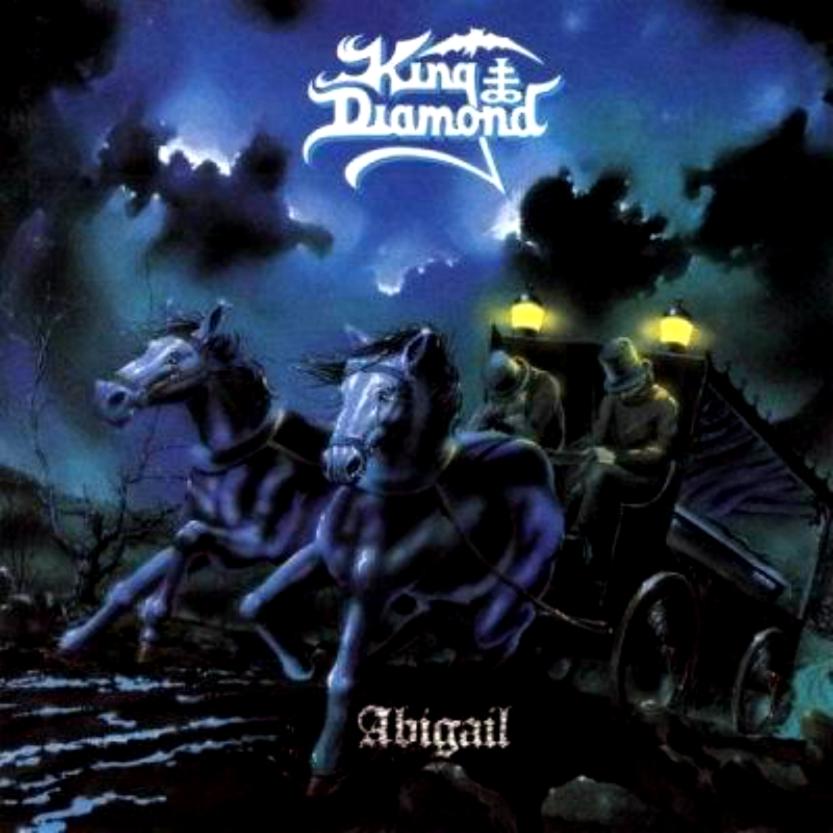
Time to switch gears. I think these might be my top 2 metal albums. I usually hate questions that ask for lists of favorites because there's usually a ton of "favorites" and different albums have their own personal qualities. But I was listening to Abigail in my car (it was probably my 3rd or 4th time through listening to it because apparently I hate taking ten seconds to switch cassettes) and just thought to myself that this might be my favorite album (ever? I don't know...metal? yes.) This album is the ultimate King Diamond classic. Sure, it doesn't have the raw edge appeal of Mercyful Fate, but this is not Mercyful Fate. No other King Diamond album consistently holds the same atmosphere and level of musicianship as heard on this album. Don't get me wrong, other KD albums are incredible as well. But the structure, vocals, and guitars on this album are just so great. The solos and leads are a perfect mesh between precision and feeling. The guitarists obviously know their stuff (theory/scales/whatever), but it sounds like they just take their knowledge of that and play straight from the heart without holding back. So many great passages on this album.

Baby Abigail was eating, Oh I cannot tell you!


Dissection's The Somberlain is another favorite of mine. I don't know if I can completely understand why. Ulver's Bergtatt was the first black metal album I heard and I absolutely loved it. So one might think that I should hold Bergtatt in a higher regard. While I do hold that album in very high regard, there is still something about this record that captivates me. It could be a bright sunny day when I put on this album, but still feel moved by the haunting guitar melodies and crushing vocals. The minute-long classical guitar passages are great as well. They work well to break up the songs and add a unique feeling to the overall album. Along with Abigail, this album is a definite influence on my guitar playing (as well as tons of other guitarists/albums, of course). Strange that two of my favorite albums have such similar artwork. Coincidence?

 I am dying! Death does heal me!


Well, I just finished The Hitchhiker's Guide, so I think my next post might be about that.

Saturday, March 16, 2013

I'm tired, no books in this post

I'm watching Independence Day right now. Don't know why, I just felt like watching the first half of it for some reason. I think one of the reasons why a lot of people rip on the movie version of Contact is because the two movies were released within a year or two within each other, and people wanted Hollywood explosions and aliens with Contact. Oh well. I enjoy that movie more than Independence Day.

At work today I spent a good portion finishing the Martian Chronicles for the third time. Such a great book. I started re-reading it to pass time last weekend when I was working a couple midnight shifts. I should bring more books to work to read during downtime. After work tonight, I came home to Borrowed Time in the house (who are borrowing Sam and Derek) before they leave for tour tomorrow morning. I also came home to a package containing Fall of Hyperion. Looking forward to reading that book. I think I'll make it the next one on my to-read list.

While I do love metal, I've found myself listening to more music from the 70's lately. A lot of progressive rock ( I started off listening to almost exclusively Italian prog rock several years ago, but I eventually branched out). There are a lot of reasons why I listen to different kinds of music. Sometimes it is simply because it rocks, other times it's because I think there's incredible musicianship. Almost all of the time, it invokes some kind of emotional response. The following albums are masterpieces. Classics. I could only hope to one day make music half as great as the music found on these records.


Tuesday, March 12, 2013

Watching bad 90's scifi/horror + reading great science fiction

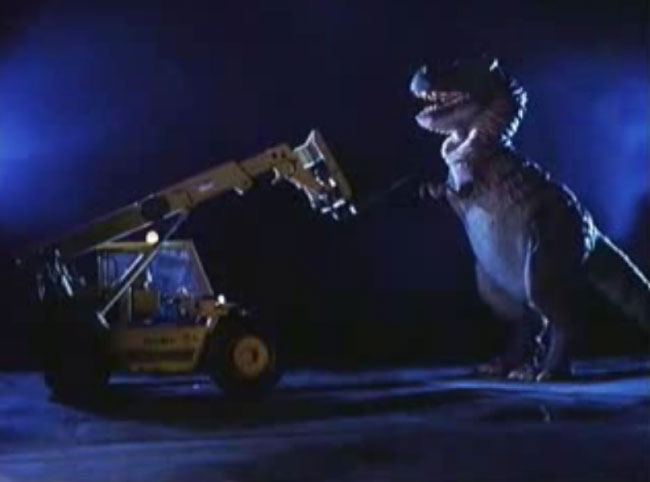
As a kid one Christmas, my brother received Carnosaur on VHS from my Grandma. She must have thought that it was going to be more of a Jurassic Park type of adventure movie. Instead, it is a bad early 90's movie about a a geneticist who plans to breed dinosaurs with spliced DNA. The movie is bad but great in its own right. More violence than you'd think a lower budget movie would have. The puppets themselves look a billion times better than if they would have used CGI animation. I'm watching the movie right now and am enjoying it very much, probably more so for nostalgic reasons. I'd implore anybody to check out the movie if they had a great amount of time on their hands, but there are plenty of other bad movies to watch other than this one.


About 2 weeks ago, I finished reading Hyperion by Dan Simmons. This was an amazing book. One that had me completely engrossed when reading it and one that had me putting off other priorities in order to read it. Often described as a sci-fi version of the Canterbury Tales, the book follows a group of people as they embark on a pilgrimage to confront the Shrike- a mysterious being who acts as the ultimate "villain" in this book. Even at the beginning of the book, it was not what I was expecting. But then again, I didn't really know what I was expecting because I didn't actually know the premise of the novel. I think the fact that it was a series of interconnected stories gave it some gravy points with me. The characters seemed flat at first, but with each character telling their story the development grew substantially. This isn't to say that that a good book MUST have excellent character development. Just look at Rendezvous With Rama. Character development was lacking in that book, however, the story and Clarke's ability to paint an evolving picture of another world is entirely unique and nearly unsurpassable. Back to Hyperion (and it's great cover art):


This book and Fall of Hyperion (it's sequel) were written as one but broken up and released separately. This explains the sudden and seemingly abrupt ending. While some science fiction relies on hypothetical technologies, galactic conflict, or alien environments, Hyperion uses excellent story telling with those elements interspersed. All of the character's tales were very engrossing. The crew involves a preacher, a poet, a scholar, a detective, a soldier, and a consul. The scholar's tale in particular was pretty depressing by itself. His daughter ages backwards until she is literally two weeks old and his wife dies in an accident. The Shrike and the Time Tombs at fault. Let me add that this book was released in 1989, so that's almost twenty years before the movie Benjamin Button (about a man who ages in reverse or something...I haven't seen it). With the development of each story, it seems like a piece of the puzzle is quietly put together as a whole. I appreciated that between stories there was a little break and an update on the progress of the pilgrimage was given. Sometimes it didn't really add much, but it was a reminder of where all the characters currently were in the story. 

The more I think about this book, the more I love the stories. Many different elements here. It's sort of a space opera, deals with A.I., time travel, poetry, and religion. It all blends well in a way that isn't smug or over the top. I give kudos to the author for having the immense talent to write in a way that is inviting and purposeful. This is a classic in my eyes, no doubt. I don't expect that Fall of Hyperion will be as great as this one, but I'm still looking forward to reading it soon to discover how the pilgrimage will end.

Monday, March 11, 2013

2013

So 2013 arrived a couple months back. If I were to say that I've been exceptionally busy, I would be lying. I work less than forty hours a week, make enough money to live on and more time to do things I like to do (as opposed to many other people). Anyways, the reason I mentioned 2013 is because I tried to impose a "resolution" on myself. Maybe less of a resolution and more of a goal. The goal was to read on average one book a week. It might be harder than I thought it was simply because I have plenty of stuff to do outside of reading- work, write, 2 classes, work on APA application, practice guitar/write songs, listen to music. But I've been trying to keep up with the reading. I decided that re-reads and graphic novels also count toward my goal. So far I've read some very awesome books that each probably deserve their own post, so I won't say what they are. I will say that they are all classics (except the last one I read). And what was the last one I read?
Neonomicon by Alan Moore and Jacen Burrows. I picked this one up on an impulsive whim. I was in Dearborn waiting for work to get done on my car. A $300 quote doubled once the mechanics started working on my car. Classic car mechanics, fucking crooks, have I ever had a good experience? Whether the markup was legitimate or not, I was still pretty upset about it. After all, I have a limited income and there are several other things that I have to and would rather spend my money on. Anyways, after drowning some of my sorrows with Thai food, I decided that spending more money at the comic book store would make me a little happier. And it did. I had actually never been inside the shop before, I always just skipped it over and went to the record store upstairs. The store itself was very cool. I won't be glib and act like I know a lot about comics, but it seemed like they had a very diverse selection overall. I had my eyes on a book that had a few HP Lovecraft stories in graphic novel format before I came across this book.
I'll be honest. The cover art didn't really catch my attention too much. The upper half looked interesting, Alan Moore's name was on it, and the title was a reference to HP Lovecraft. Actually, I just now realized that the title is "Neonomicon" and not Necronomicon. That's interesting. Time to go back and change the title. Anyhow, my interest was peaked and I did a quick flip of the book, I came across some pages which included copious amounts of nudity and violence. Some of the artwork looked too cool to pass up, so I was sold on it. Kelly (lady at the counter) said it was a good choice and hoped that I was not easily offended. Luckily I'm not easily offended (if it was any other member of my family, it'd be a different story). I read half of the book when I was waiting for my car and the other half when I came home later on. I always try to justify the amount of money I spend on something with the amount of enjoyment I get out of it. That's why I love used books so much. At a couple of dollars you get several hours of art, knowledge, and entertainment. I thought this was a little steep at $20 new, but was still probably worth it.
What starts off as a potentially X-Files type comic quickly spins into an environment occluded by drugs, sex, HP Lovecraft mythology, and occultism. It's fun, interesting, kind of cheesy, and a little grossly fucked up at certain parts. Alan Moore's writing is more straight forward and I would definitely not hesitate to say that this is probably one of his darkest works. I wish I had read more Lovecraft to catch more references. I am slowly working on it though by working my way through his collection. What this comic really is missing is length. I wish it was a little longer. It was a very quick read (6 separate issues altogether, I believe). I feel like once the story really gets going, it ends a little too abruptly. Kind of like if Free to Live by Winterhawk was only half as long. The song would still be great, but there would be 4 and a half minutes of incredible guitar magic missing. Nonetheless, the comic was a lot of fun and made me remember how great graphic novels can be. I read V for Vendetta almost 3 times already. Time to re-read Camelot 3000 and a few others; and try to find some other comics as good or as insane as this one.

Thursday, March 7, 2013

An unposted draft from 7 months ago

Lots of stuff going on in the last few weeks/month. In short...I finished the mortuary science program at WSU, took (and passed) both parts of the National Board Exam, and started working full time (9-6 M-F isn't THAT bad..so far at least) So obviously, I haven't had a great amount of time to fulfill my objectives on my 'to-read' list. In between the time I spent studying, I checked out a few books from the library. Canticle for Lebowitz, Time Enough For Love, Left Hand of Darkness, and The Demon Haunted World. Unfortunately, all I managed to accomplish was about half of The Demon Haunted World and nothing else. I did manage to accumulate 15 bucks in late fees as well. Late fees suck. This book, on the other hand, does not suck.


I can't stress enough how much I love Carl Sagan. I remember first watching Contact in my mom's then-boyfriend's (essentially my stepdad) apartment with the two of them and my brother. I remember at the time I thought it was a mix of interesting and boring. I was more interested in the fact that a person said "shit" in a PG rated movie. I was also more interested in watching Good Burger after that movie. I wish my 9-year-old self would've paid more attention to this movie. I watched the movie several years later and realized how great it was. I constantly hear/read negative reviews about the movie and, although I completely disagree, I guess I might see where a lot of these people are coming from. Several people call it boring, some call it anti-climatic, some call it a waste of time. I couldn't disagree more. The story is a realistic approach of the discovery of life on another planet. It doesn't have guns everywhere or constant explosions. And I truly believe that's why a lot of people don't like it. It's not an action movie or horror movie. It is a million times more subtle than Ridley Scott's Alien but just as epic in it's own right. Maybe the average Hollywood movie consumer wasn't ready for thinking just yet.
This book isn't Contact though. This non-fiction book is like porn for science enthusiasts and logical thinkers. I only read half of it, but will eventually give it another go once I get more situated to this working lifestyle. The first half that I read was good though. At times, it did seem like he was being very critical. For example, the section on UFO's I really liked but also felt a little like he...(*this was the end of the draft*). I don't remember what train of thought I was on. I now own this book so I can re-read it anytime I want and I will have to do so if I want to give this book a proper review. Instead, I"ll point out that Carl Sagan has become increased in "popularity" over the past year due to social media. Actually, I think the same can be said with Bill Nye and Neil Degrasse Tyson. I guess it's no coincidence that these are also some of the most known science popularizers, but there seems to have been an inkling of a resurgence. Good thing, right?
I will eventually re-read the book even though some of the parts felt like they were being hammered over too much. And that's the overall theme of the book- he takes subjects that have no legitimate scientific basis (astrology, Sasquatch, UFO's to name a few) and tears them apart through his own personal blend of reasoning and skepticism. He wants the reader to understand that several million Americans and others around the globe are scientifically illiterate. He desperately wishes to raise awareness of this fact and accomplishes his goal by also instilling a desire to increase your knowledge in several aspects. This wasn't the best review, but that's okay. I know I will eventually read the book in full so I can appreciate it in it's entirety. 

Sunday, August 19, 2012

The Martian Chronicles


     I love this book. I first read it in my 10th grade English class and gave it  a re-read after reading about Bradbury's death this past June. When he died, my Mom said to me that this was possibly the last of the great classic sci-fi writers to bite the dust, which may be arguably true. Ursula Le Guin is still alive and kicking somewhere. But her writings can be argued as more fantasy than science fiction. Larry Niven is still alive, William Gibson, Orson Scott Retard. These names just don't hold the same strength as Isaac Asimov, Robert Heinlein, Arthur C. Clarke. 
    When I read this book in school, it was a requirement for the class. We had tests and quizzes on it, which was probably an attempt to reinforce our reading comprehension skills. Unfortunately with my stubbornness, I didn't really like being told what to do. But also..I really didn't like being told what to read, ESPECIALLY when it came to fiction. I read the book as required and convinced a part of myself that it was a solid waste of time. But I knew that a large part of myself was really captivated and wanted to continue to turn the pages. So I did and I enjoyed it. I'm very grateful that it was required reading. 
     There's always the saying that you can remember exactly where you were and what you were doing when a significant event (like 9/11) happens. On 9/11, I was in a middle school classroom and my teacher told me about it. She, all the other faculty members, and a some other students were in a state of shock. I didn't know what the twin towers were and certainly didn't understand the magnitude of the event. I'm sure I might react a little differently nowadays (although my general apathy probably hasn't gotten too much better since then). Anyways, going along with this idea of remembering where you were during significant events... What's special to me is that I remember where I was and what I was doing when learning about the deaths of several great writers. When Vonnegut died, I was in my friend's dorm room (I was a senior in high school) and I saw it on his facebook feed. When I read the news, I acknowledged Vonnegut as one of my favorite writers at the time and said that it was a bummer. My friend didn't know who he was then so he couldn't share my sentiment. I did see him reading Cat's Cradle about a year later though. When I found out about Bradbury's passing, it was a very nice sunny day and I was on my computer. I saw the news on Yahoo news and was immediately taken aback. Because of his status as a writer and his literary accomplishments many years ago, I expected that he had already passed away before my time. I had never really taken the time to research more about him and understand where he was. After giving myself a good slap in the face, I went forward and read about his life. Reading of his death re-ignited my love for reading science fiction literature. That same day, I went over to the undergrad library and rented the Martian Chronicles for a good old re-read and Stranger in a Strange Land for a good old first-read. I was also reading Dune at the time (second time around- I read half of it first and didn't pick it up for a while, so I just started over).
     This book itself is a collection of short, slightly inter-related stories. It depicts Martian life, first contact, and colonization efforts. But the thing about the book is that it can be read even if you're not a fan of sci-fi. And that is attributed to Mr. Bradbury himself. I don't know what it is about his writing that makes it so flowing and so elegant at the same time. He has the voice of a true storyteller. I find no other way to describe it besides warm even in the darkest parts of the book. There's a great story in the book for anybody who is a fan of E.A. Poe. One might even find early influences for Farenheit 451. What I find very peculiar as well is how the majority of the Martian population died- a disease epidemic introduced by foreign colonizers. Sound vaguely familiar? Does North America some several hundred years ago ring a bell? Overall, a great book that I would encourage high school English teachers to force onto their students. Honestly, it was probably the best thing that I was made to read in high school.

Tuesday, August 14, 2012

Sci-fi with a Cool Title

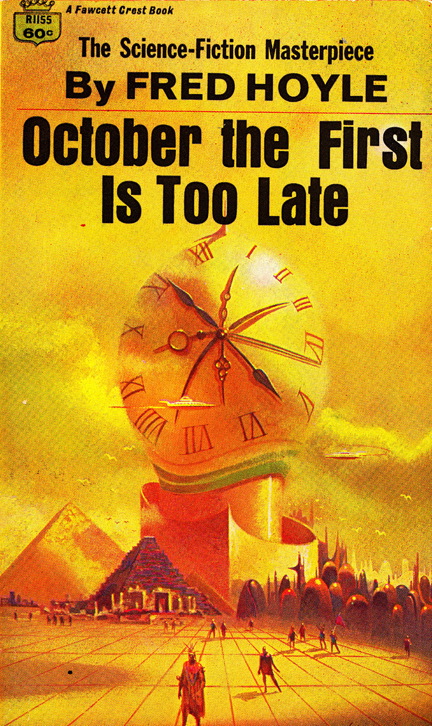
    October the First is Too Late. This book is actually a little oddly captivating at times. Many people are not very fond of the title, but the title is what made me interested in reading this book. That and of course the cover (And Sir Fred Hoyle for that matter). I'm not entirely sure what it's supposed to be, but what I can say is this: Any book that has great cover art (like most of these books from the 60's-80's) or a cool title will most likely get my stamp of approval. Sure, much of the stuff might be pulp or juvenile, but that doesn't stop it from looking awesome. Sci-fi books from this time are kind of like old heavy metal records. There are so many albums with really cool covers. Heavy Load, Mercyful Fate, Dark Wizard, etc. A lot of them are great albums, but some of them are mediocre, some are not good, and some are incredible. Same can be said with 60's/70's prog albums. So much cool artwork. Again, some are awesome and others mediocre, but they are almost always good in some respect. Whether it's a sci-fi book from the 60's, a prog album from the 70's, or a heavy metal record from the 80's, there's usually going to be some good thing about it. I might say that I was born too late.


     I'll give my abbreviated summary of this intriguing little story. More of novella than a novel, it is a story of 2 people (a composer and a scientist) who get caught in an altered rift of time. Hawaii seems to be in present time, England seems to be caught in an early world war, most of North America seems to be several hundred years in the past, Deserts near Russia seem to have a flat and glass-like surface, and Greece seems to be caught in their classic period. It is a pretty cool idea for a short book.
     The first major event happens when the two are in Hawaii and get word that the entire coast of California has disappeared. They travel there via plane to investigate and observe the coastline has no buildings and no evidence of civilization, just trees and natural landscapes. They travel across the country and see that everywhere else is in the stage of what it might have looked like several hundred years ago. When they arrive in Britain, they realize that they've entered a time during WW2. One of the men travels to Greece and finds himself in Ancient Greece where Socrates is out and about (although the main character never gets to speak with him...that would've been funny). Eventually, the main character decides he needs some space from the culture and seeks solace in an old temple outside of the city where he works on composing his greatest piece of music yet. He is challenged by a beautiful woman to a musical "duel" of sorts. He awakens the next day to find himself in a new place. Everything is pretty minimal, but the technology is way past present-day standards. Apparently, he is a few thousand years in the future. He and his friend discover that they have been brought here by the woman from the  musical duel in Ancient Greece. They watch a very abbreviated four hour history of the world to get them caught up to the current time. The pattern they see is of a civilization building itself up and then eventually collapsing and destroying itself. It happens over and over for several hundreds of years until the current time. Eventually the two men get a choice to stay in the future or go back. One elects to go and one elects to stay, the end.
     Obviously, there is always a lot more to the books than my abbreviated summaries, but this is basically how it went. The author actually does a decent job of peppering in meaning to the entire story with analogies of dimensions and rabbit holes. You could tell a little bit of thought actually went into it. The book is typically met with good to mediocre (and even some poor) reviews. But I think it is pretty decent, you could probably read it in an afternoon if you have the time. I'm going to go back to studying for the NBE now.

Thursday, August 9, 2012

Mortuary Science Pathology

Happy Birthday to me. After band practice last night, I enjoyed some chocolate stout and sake. Earlier in the day, however, I was studying for the national board exam for mortuary science. During that time, I spent a good amount of time gazing into this book:


     Yes, a textbook. I was contemplating whether to include texts or not. I decided that if I read them and enjoyed them, why not? This book is actually really cool, even if you are not that into textbooks or anything of the like. Not only does it provide basic terms for post-mortem evaluation purposes. But it is especially interesting because it outlines specific diseases and situations and how they would have an effect on the post-mortem body. I can now recognize patterns of disease/trauma and understand how a licensed embalmer could approach  these cases. For example.. Burn marks on or near the scrotum with no other apparent trauma? Lightning strike.
     Embalming is hardly an exact science but efficiency is tripled when you can recognize the signs that may have an effect on it. There is a lot of information within this book, but it is hardly overwhelming. From its initial introduction, it shares the scope of study of disease for mortuary science specialists (including fluid distribution, injuries, genetic basis, neoplasia, infection, etc). It gives you basic information concerning the mechanism of specific diseases and how they contribute to the signs and symptoms. I really enjoy how the book is written because it allows you to absorb the basic information while also providing an introductory glimpse into the actual 'why' of the process. Obviously it's not as heavy as Robbins Pathological Basis of Disease or other pathology texts. But it serves as an excellent introduction for students (primarily those in mortuary science) who aspire to learn more about pathology and its relationship to the post-mortem body.

Monday, August 6, 2012

Intro + Book 1

     Well, I made this blog pretty much just for myself so I could document what books I've read, with maybe some occasional music thrown in. I don't know what it is about science fiction, but I find myself limiting the fiction I read to this genre. Maybe it's because so much of these sci-fi books and stories have applications that can applied in the real world? Maybe I'm drawn to it because of my own alienation with others? Maybe it's because it inspires us to learn more. In many cases, science fiction of the past has turned into science fact of the now. Science fiction instills wonder, hope, curiosity, and interest. It can even provide blueprints of how science was thought of in the past and present.
     I guess the bottom line for me is sometimes I'll read a book but only slightly recollect the premise when I look it up a year later. So hopefully this blog will help me recall and remember the good things I've read from here on out. To start it off, I'll just go ahead with this:


     I wish I had been smart enough to read this book back in high school. But I wasn't. In fact, I just read it about 3 months ago. After I was done reading it, I found out that I had read the version that was trimmed for publication. I'm kind of grateful for that because now I get to read the unabridged version and compare the differences (I'm sure the unabridged will be better). 
     This book is so interesting because while it is based in sci-fi, it deals primarily with real-world applications. Definitely would not call this a science fantasy novel like the cover of this version suggests. The story follows Valentine Michael Smith, a human who was born on Mars and raised as a Martian. When another Mars expedition finds him, he elects to travel back to Earth. He is not acclimated to Earth's climate and gravity at first but recovers quickly when in the hospital. Smith looks like a regular human, however that is about the extent of it. He can read a book in about as fast as it takes us to read a few pages, he has several psychic abilities that humans may be capable of reaching but have not. He doesn't know what a female is. He doesn't know what God is, what love is, what laughter is. But he wants to learn, and he wants to grok.
     I see two parts to the book. The first part, where he is truly A Stranger in a Strange Land and is unaware of peoples intentions and what specific items are used for. The second part, where he is still a stranger, but more accustomed overall. He finds more confidence and purpose. A large part of the book focuses on religion and spirituality. Smith, who eventually gets very rich because of some earthly circumstances, builds his own space (temple?)  and allows people to learn his 'Martian ways'. It's described as a religion by some and as a cult by others. And while it might have elements of both, it really is neither. There are practices of free love and psychokinesis strewn throughout. In my opinion, he is really unlocking barriers that humans have placed upon themselves. These barriers that Martians have somehow broken down.
     Stranger in a Strange Land is a really great story about a human Martian who is trying to understand why humans act the way they do. While it asks you to question human nature and who you are, it's not all "hey look at me, I'm serious." It has several uplifting moments as well. On the other hand, I find humor in strange things. Robert Heinlein is probably more known for his patriotism and sexist undertones. I'm not really one to advocate either (sexism sucks, yeah I know), but I'm also not going to completely disregard an author/artist based on his or her personal beliefs (ie. Orson Scott Card, who sounds like a HUGE douche in person, wrote the highly acclaimed Ender novels). In the end however, there is more to this book than I can type on here and I would implore anyone to read the unabridged version. 
     Upon finishing it, I thought to myself, "That might be my favorite book I've ever read". Although to be honest, I find myself saying that somewhat often when I read books that I really enjoy.